
Bank Statement Analyzer: How It Works, Key Insights and Business Use Cases
Explore how a bank statement analyzer extracts transactions, evaluates cash flow, identifies income patterns and supports financial assessment and risk analysis.
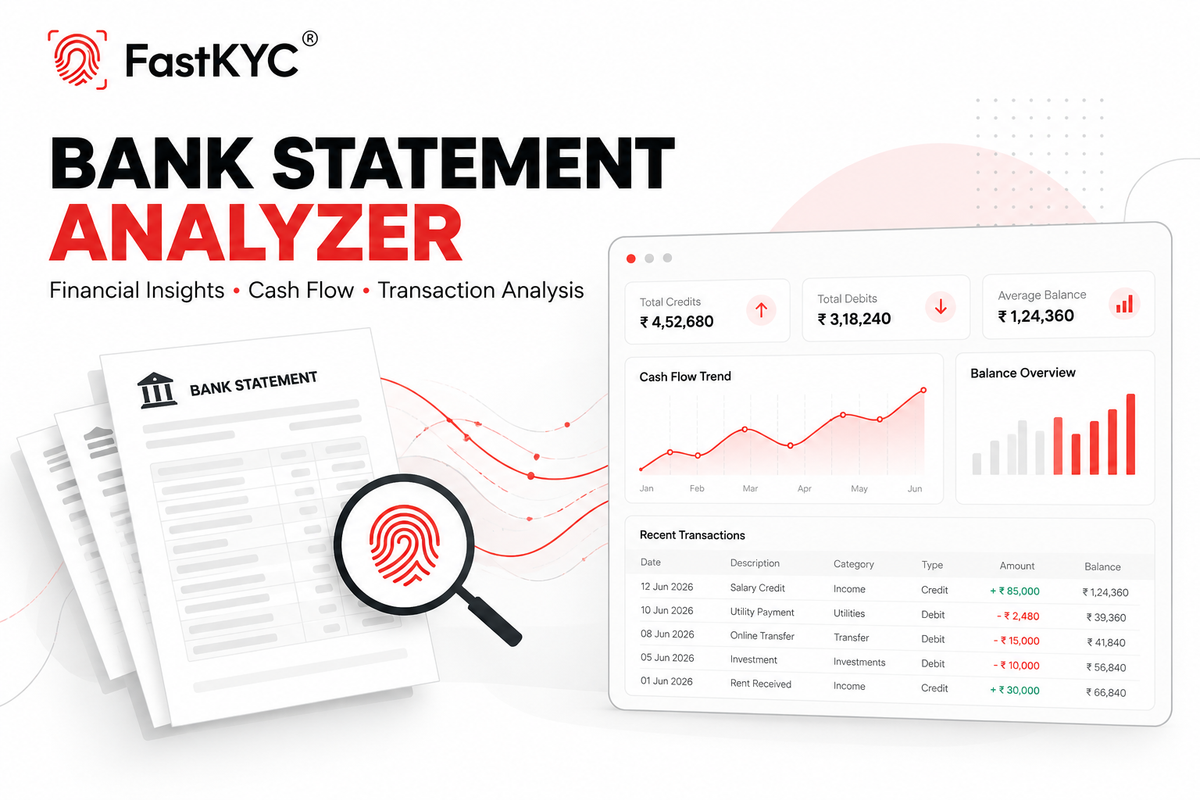
A bank statement is more than a list of deposits and withdrawals. It is a detailed record of financial behaviour that reveals cash-flow patterns, balance trends and recurring obligations.
For lenders, fintechs and financial service providers, turning this raw data into structured insights supports faster assessment and better operational decisions. A Bank Statement Analyzer (BSA) does exactly that: it converts bank-statement information into organised data and meaningful financial summaries.
In India, Account Aggregators (AAs) can complement this process by enabling secure, consent-based access to eligible financial information from participating institutions.
What Is a Bank Statement Analyzer?
A Bank Statement Analyzer is a tool that extracts and analyses financial information from bank statements (PDFs, scanned images or structured data feeds).
Instead of leaving the information in document form, it organises it into consistent fields and analytical summaries. Typical outputs include:
- Account holder and bank details
- Statement period and balances
- Total credits and debits
- Daily end-of-day balance trends
- Major transactions and categories
- Recurring credit and debit patterns
- Configurable financial indicators that may need further review
The results support lending workflows, MSME assessments, reconciliation and internal reporting. A BSA provides analysis and flags; it does not independently verify every transaction or decide creditworthiness on its own.
How Bank Statement Analysis Works
The process generally follows these stages:
- Document or data input – The statement (or AA-sourced data) is submitted.
- Data extraction – Text is read directly or via OCR for scanned documents.
- Structuring – Account details and transactions are mapped into standard fields.
- Calculations – Metrics such as totals, averages and balance ranges are computed.
- Pattern analysis – Recurring items, categories and unusual movements are identified.
- Report generation – Structured output (often JSON) is returned for review or system integration.
Multi-page handling, balance reconciliation and validation checks are essential to reduce missing or duplicated entries.
What Information Can Be Extracted?
Account information (when present in the source): name, bank, branch, account number, IFSC/MICR, account type and statement period.
Transaction information: date, description, debit/credit amount, running balance, and payment mode (UPI, NEFT, IMPS, ATM, etc.) when identifiable.
The structured output can be consumed by other applications without re-parsing the original document. Extracted fields should still be treated as derived data, not independently verified facts.
Cash Flow and Balance Trends
Useful metrics include:
- Total credits and total debits
- Opening and closing balances
- Average end-of-day balance
- Maximum and minimum end-of-day balances
A high closing balance can be misleading if a large deposit arrived only at the end of the period. Daily end-of-day analysis shows how funds actually moved and how often the account was under pressure. The calculation method (especially treatment of missing days) should always be clearly defined.
Transaction Patterns and Financial Indicators
Categorisation groups transactions by type (UPI, NEFT/IMPS, ATM, salary-like credits, EMIs, rent, etc.).
Recurring activity highlights repeated credits or debits that may represent salary, rent, subscriptions or supplier payments. Frequency and total amount are reported; the tool does not automatically confirm the true purpose of every entry.
Major transactions surface the largest inflows and outflows for quick review.
Risk indicators may flag unusual balance swings, large one-off movements, frequent withdrawals or patterns that differ from expected behaviour. These are signals for further investigation, not proof of fraud or poor credit quality.
How Account Aggregators Use Bank Statement Analysis
India’s Account Aggregator (AA) framework enables consent-based sharing of financial information between participating institutions. When combined with a Bank Statement Analyzer (BSA), it helps financial institutions obtain authorized financial data and convert it into meaningful financial insights.
How AA and BSA Work Together
- Customer Consent: The customer provides consent to share financial information for a specified purpose.
- Data Sharing: The Account Aggregator facilitates the transfer of authorized data from the Financial Information Provider (FIP) to the Financial Information User (FIU).
- Data Processing: The receiving system prepares the retrieved information in a format supported by the Bank Statement Analyzer.
- Financial Analysis: The BSA analyzes transactions, credits, debits, cash flow, income patterns, recurring payments and balance trends.
- Generating Insights: The results help financial institutions assess account activity and support workflows such as customer onboarding and lending assessments.
By combining AA-based data access with bank statement analysis, institutions can reduce manual statement collection and streamline financial assessment. Since AA data may arrive in a structured format rather than a PDF, the analyzer or an intermediate processing component must support that format. Customer consent, data validation and appropriate security safeguards remain essential throughout the process.
Business Use Cases
- Lending and loan assessment – Cash-flow patterns, average balances and existing obligations help evaluate repayment capacity alongside bureau data.
- MSME / working-capital assessment – Seasonal revenue, irregular collections and operating expenses become visible, supporting cash-flow-based underwriting.
- Financial reconciliation – Structured transactions can be matched against internal records.
- Personal-finance applications – Categorisation and balance trends help users understand spending and savings.
- Internal reporting and dashboards – Consistent fields feed assessment tools and operational workflows.
- Bank Statement Analysis
- Cash Flow Analysis
- Financial Services
- Credit Risk Assessment